As a parent, walking into a video game store with your child can be overwhelming. How can you know what your child is actually playing? How can you avoid violent and otherwise degrading material? The task can feel daunting, which is why we, a group of college students who are concerned about raising awareness about the effects of violent video games, have created a list of five ways to make sure your child is playing appropriate video games.
1) Consider your child's age
Older children can be exposed to more violence and other thematic elements with less effect. As your child matures, he or she may be able to handle more content. Be sure not to decide only based on their age, but on their social, emotional and mental maturity, how much violence you should allow in their gameplay. Also, be sure to limit the amount of time they play any game.
A recent study found that young boys spend an average of 13 hours per week playing video games. This is much more than the recommended amount, especially for violent video games. Remember that children under 18 should limit their violent gameplay to 30 minutes per day.
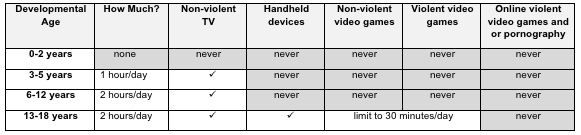
This chart and information for this section was borrowed from an article by The Huffington Post, which contains more useful information about children's use of video games by year. If you'd like to see this article, use this link.
2) Check the rating
40% of children surveyed said their parents have never checked the rating of their video game (Gentile, 2003). As a parent, make sure you never skip this step! If you want to have a say in your child's media consumption, the first place to start is with the rating. You can usually find a game's rating on the back of the box. In case you are a little unsure about choosing a video game based on its rating, here is a list of the ratings and how to interpret them. For more info about game ratings, click this link.
 "Early Childhood" - These video games have content specifically designed for, you guessed it, young children. You can expect the content to have no violence, easy gameplay for kids, and some possible educational elements.
 "Everyone 10 and up" - These video games are similar to 'E' rated video games, but they may have slightly more violence, stronger language, and other elements that may be offensive. Make sure your child is old enough and be willing to give, like in a PG-rated movie, parental guidance when necessary.
"Teen" - Games rated 'T' contain much more violence, some gore, strong language and possible sexual themes. Liken this rating to a PG-13 movie: make sure your children are mature enough to handle the content and, even if they are, don't let them play for longer than thirty minutes, as discussed above.

"Mature" - 'M' rated games are like R rated movies: if you are concerned about exposing your children to violence, they should not be playing these games. M-rated games tend to include lots of violence, sexual themes, intense language and other inappropriate material.
 "Adults Only" - These video games include even more violence, intense blood and gore, longer sexual scenes, and more violent language. Children and adolescents should not be exposed to this material, as it could be detrimental to their social and emotional health.
3) Check for violence
The effects of violent video games have been studied for over a decade. At this point, a substantial amount of evidence has been found that suggests that exposure to violent media can cause aggressive behavior in children and adolescents (Anderson, 2007).
Studies have been conducted that say the opposite, but I can't help but agree that violent video games cause aggression because of a personal experience with my brother.
When I was younger, I remember watching my brother play shooter games on our Playstation 2. When he didn't do well on a level or someone made him mad, he would throw the paddles across the room and sometimes break things. I know the amount of violence in the game is one of the reasons he believed violence was an appropriate way to express his emotions. Now that he's almost an adult, he has more control of himself when he plays games, but I know he would have been a less aggressive child if he wouldn't have played violent video games.
My personal discussions with him and others who knew him agree with me, so I feel telling others his story is important. I believe violent media can be harmful.
However, avoiding violent media can be difficult. One study found that 89% of video games contain violence (Bartlett, 2014). So you might wonder, how can I let my child play video games they enjoy without ruling out a majority of popular games?
Children have a difficult time discerning fantasy and reality (Gentile, 2013). Some games, such as the Grand Theft Auto series, contain more realistic violent material like blood and realistic scenery. Other games, such as Super Mario Smash Bros., contain less realistic violence because the characters have special, unnatural abilities and fight each other in an imaginary world.
If you must buy violent video games for your children, make sure the content veers away from realistic content and leans toward mild, unrealistic violence.
4) Ask other parents what they know about the game
In this digital age, almost every parent is faced with the difficulty of choosing appropriate media for their children, so you aren't alone. Ask your neighbors if they have bought any new games recently. Ask a church friend if he has heard anything negative about a particular game you are interested in. Ask your mother-in-law if she would let her kids play the game. There are many possibilities, so remember: you aren't in on it alone.

5) Check-up with other concerned parents on online game rating sites
There are several online game rating sites on which other concerned parents have written every detail about a particular video game that they find offensive, inappropriate, or exceptionally violent. Use these websites to your advantage. Even if no one around you has heard of the game, chances are someone has, and they will be willing to guide you in your decision. Here are a few online-game websites for the conscious parent.
- Common Sense Media - This website includes a rating from one to five in several categories, including positive messages, positive role models, ease of play, violence, sex, language, consumerism, drinking, drugs & smoking, and privacy. It also has descriptions of the game, a quality rating, and a suggested age.

- The Source for Parents - This website includes longer descriptions about content, but doesn't give ratings like Common Sense Media. It looks into factors such as violence, language, and sexual and spiritual content.

Works Cited
Anderson, Craig A., & Gentile, Douglas A. & Katherine E. Buckley. Violent Video Game Effects on Children and Adolescents: Theory, Research, and Public Policy. Madison Avenue: Oxford University Press, 2007. Print.
Barlett, Christopher P., and Christopher
Rodeheffer. "Effects Of Realism On Extended Violent And Nonviolent Video
Game Play On Aggressive Thoughts, Feelings, And Physiological Arousal."
Aggressive Behavior 35.3 (2009): 213-224. Academic Search Premier. Web. 9 Sept.
2014.
Gentile, Douglas A. Media Violence and Children. Westport: Praeger, 2003. Print.
Ivory, Adrienne Holz, and Christine E. Kaestle.
"The Effects Of Profanity In Violent Video Games On Players' Hostile
Expectations, Aggressive Thoughts And Feelings, And Other Responses." Journal
Of Broadcasting & Electronic Media 57.2 (2013): 224-241. Academic
Search Premier. Web. 9 Sept. 2014.
